
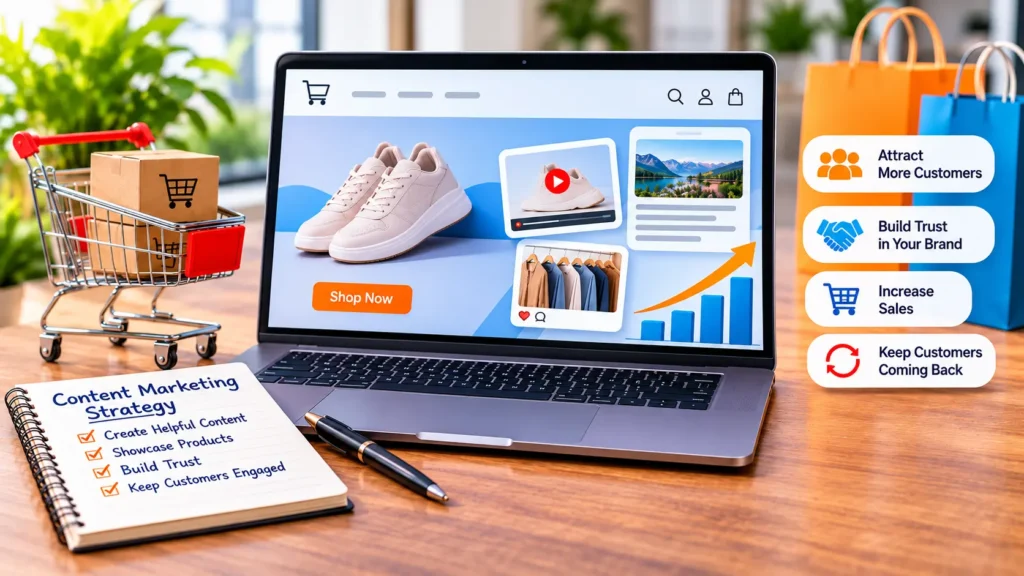
Ecommerce content marketing means publishing useful content that helps people find your online store, choose a product and come back to buy again. That includes buying guides, comparison pages, product and category copy, care and how-to articles, reviews and the emails you send after a sale.
This guide explains what to publish at each stage of the buying journey, how to plan it, how to measure it and which mistakes to avoid. It is written for store owners and marketers, and it uses Google’s own advice on helpful content where it can.
Ecommerce content marketing is the practice of answering the questions shoppers ask before and after they buy. Start with the pages closest to a sale, such as category pages, product pages and buying guides, then add comparison and how-to content. Google says people-first content is content created primarily for people, so write for shoppers and check that each page adds something a reader cannot get from the product page alone.
Table of contents
- What ecommerce content marketing is
- Why it matters for a store
- Types of content a store can publish
- Content for each stage of the buying journey
- How to plan it in seven steps
- Buying guides and comparison pages
- Product and category page copy
- Reviews and customer content
- Content after the sale
- Getting the content seen
- How to measure it
- Four examples
- Common mistakes
- FAQ
- Where to start
What ecommerce content marketing is
Content marketing is the practice of attracting and keeping customers by publishing things they find useful, instead of only advertising to them. In ecommerce, the content sits around the product: the information a shopper needs to decide, the help they need to use it and the reasons to come back.
It is not the same as filling a blog with posts. A store can have strong content and no blog at all, if its category pages, product pages and guides answer the questions shoppers actually have. Some people call this approach content commerce, because the content and the shop are part of one experience.
What counts as content
- Pages that help someone choose. Buying guides, size guides, comparison pages and “best for” pages.
- Copy that describes products. Product descriptions, category introductions and filter labels.
- Help after the purchase. Setup instructions, care guides, FAQs and replacement part pages.
- Proof from other customers. Reviews, photos and questions and answers.
- Messages you send. Welcome, abandoned basket and post purchase emails.
Why it matters for a store
Paid ads bring shoppers when you pay for them. Content can keep working after you publish it, and it also helps your ads, emails and product pages do their jobs.
- It reaches shoppers who are still deciding. Many people search for help before they search for a product.
- It answers objections. Sizing, delivery, returns, materials and compatibility are the usual reasons people hesitate.
- It supports search. Pages that answer real questions give search engines more to show.
- It lowers support work. A clear guide answers a question once instead of many times by email.
- It builds repeat sales. Customers who learn to use a product well are more likely to return.
Content does not replace a good product or fair prices. It helps good products get found and understood.
Types of content a store can publish
| Type | What it does | Example (made up) |
|---|---|---|
| Buying guide | Helps a shopper choose between options | “How to choose a backpack for a week of travel” |
| Comparison page | Sets two or more options side by side | “Cotton vs bamboo bed sheets” |
| How-to article | Shows how to use or care for a product | “How to season a cast iron pan” |
| Category copy | Explains a range and helps filtering | An opening paragraph on a running shoes category |
| Product page content | Describes the item and answers doubts | Dimensions, materials, sizing notes and a short video |
| Customer content | Shows real use and opinions | Reviews with photos, questions and answers |
| Email content | Brings people back | A care guide sent a week after delivery |
Content for each stage of the buying journey
Shoppers do not arrive ready to buy. A simple way to plan is to cover four stages, and to start with the ones nearest the sale.
Stage 1: Discover
The shopper has a problem but not a product in mind. They search for ideas or answers, such as “how to keep a small kitchen tidy”. Content here is broad: ideas, inspiration and explainers that lead to your range.
Stage 2: Compare
The shopper knows what kind of product they want and is weighing options. Buying guides, comparisons and “best for” pages help most here, along with honest notes on who each option suits.
Stage 3: Decide
The shopper is close to buying and looking for reasons to trust you. Product pages, reviews, size guides, delivery and returns information matter most.
Stage 4: Keep
The shopper has bought. Setup help, care guides and useful emails encourage a second purchase and reduce returns.
If you are short of time, start with stages 3 and 2. They are closest to revenue, and weak pages there cost sales that other content cannot recover.
How to plan it in seven steps
- Write down the questions. Collect what customers ask in emails, chats, reviews and returns notes.
- Find the words shoppers use. Our guide to what SEO keywords are shows how to check search terms with free tools.
- Pick the products that matter. Start with items that have good margins and steady demand.
- Map content to stages. For each product group, list one guide, one comparison and one care article you could write.
- Set a simple standard. Decide what every piece needs: a clear topic, real detail and a link to the related products.
- Publish in order. Fix the pages nearest the sale first, then add guides.
- Review and update. Check the pages every few months, and update prices, stock and facts.
How much to publish
There is no ideal number. A store with 50 products can do well with ten strong guides and well written category pages. Quality and relevance matter more than how often you publish.
Buying guides and comparison pages
Buying guides are often the best content for a store, because they meet shoppers while they are choosing. A good guide helps someone decide even if they buy elsewhere, and that is why it earns trust.
What a good buying guide includes
- The decision in plain words. What the shopper is choosing between and what matters.
- Clear criteria. The two or three things that really separate options, such as size, material or use.
- Honest recommendations. Who each option suits, and who it does not.
- Links to products. Natural links to the items you sell, not a wall of buttons.
- Evidence. Measurements, photos and your own testing where you can.
Google’s page on writing high quality reviews suggests showing that you know the subject, sharing measurements about how something performs and explaining what sets it apart from its competitors. The same advice works for guides and comparisons.
Product and category page copy
Product and category pages are content too, and for many stores they matter more than any blog. Google’s page on structured data for ecommerce sites lists product markup as a way to tell Google more about your products, and good copy gives that markup something accurate to describe.
Product pages
- Write for the question behind the click. Size, fit, material, compatibility and what is in the box.
- Do not copy the supplier text. Many sellers use the same text, which makes your page one of many.
- Use real images and short video. Show the product in use and at scale.
- Be clear about delivery and returns. Put the short version near the buy button.
Category pages
- Add a short introduction. A few lines saying what the range is and how to choose.
- Label filters in shopper words. “Waterproof” and “fits wide feet” help more than internal codes.
- Link to related guides. Send undecided shoppers to the help they need.
Our ecommerce SEO service covers category and product page work in more detail.
Reviews and customer content
Reviews are content that shoppers trust because other customers wrote them. Photos from buyers, questions and answers, and short “how I use it” notes add detail you could not write yourself.
- Ask after delivery. Send a request when the customer has had time to use the product.
- Make it easy. A single link, a few questions and the option to add a photo.
- Show the good and the bad. A page with only five star reviews looks less believable.
- Reply to concerns. A calm, helpful reply shows how you treat customers.
Check the rules of your country and of each review platform on incentives and disclosure before you offer anything in return for a review.
Content after the sale
Content marketing does not stop at the order. Setup guides, care tips and “how others use it” emails help customers get value, and satisfied customers buy again.
- A thank you with the next step. What to expect, and where to get help.
- A care or setup guide. Sent when it is useful, not on day one.
- A review request. Sent after the customer has used the product.
- A related product suggestion. Only when it really goes with what they bought.
Our guides to ecommerce email marketing and targeted email marketing explain the flows and the rules.
Getting the content seen
Publishing is half the job. Content needs a route to the people who want it.
- Search. Give each guide a clear topic and a descriptive title, and link it from related products and categories.
- Email. Share new guides with subscribers who showed interest in the topic.
- Social and communities. Share the parts that help, and join conversations where you can be useful.
- Your own site. Link guides to products, and products to guides.
- Customer service. When someone asks a question, send them the guide.
How to measure it
Measure the effect on sales and on shoppers’ behaviour, not only visits.
- Visits to content pages. Where they come from and how many keep browsing.
- Orders that start on content. Look at orders from sessions that touched a guide.
- Search visibility. Impressions and clicks for the topics you cover, from Search Console.
- Conversion on key pages. Did product and category changes lift the share of visitors who add to basket?
- Support questions. A fall in repeated questions shows a guide is working.
- Repeat purchases. Compare customers who read after sale content with those who did not.
Be careful with attribution. A guide often helps a sale that is credited to another channel, so look at the whole journey, not one click.
Four examples
These examples are made up, to show the idea. They are not results from any store.
A coffee equipment shop
A comparison of pour over and espresso machines for beginners, with one clear recommendation for each type of drinker, links to the machines and a follow up email on cleaning.
An outdoor clothing shop
A guide to layering for cold weather, a size and fit page with measurements, and category copy that explains which jacket suits which activity.
A pet supply shop
Care guides by pet type and age, a comparison of food types and a “what to buy first” page for new owners.
A home furnishings shop
A room planning guide, a materials comparison and product pages with dimensions, care notes and short videos.
Common mistakes
- Publishing for search engines only. Google asks whether a reader will leave with a satisfying experience, so write for shoppers.
- Copying supplier text. It gives you the same page as every other seller.
- Ignoring category pages. They often matter more than the blog.
- Writing about topics with no link to your products. Traffic that cannot buy is of little use.
- Never updating. Out of date prices, stock and facts hurt trust.
- Measuring only traffic. Visits do not pay the bills.
Ecommerce content marketing FAQ
What is ecommerce content marketing?
It is publishing helpful content, such as guides, comparisons, product copy and emails, to help shoppers find your store, choose products and buy again.
Do I need a blog for my online store?
Not always. Strong category pages, product pages and a few buying guides can do more than a blog that is rarely updated.
How do I find topics for ecommerce content?
Start with customer questions from emails, chats, reviews and returns. Then check the words shoppers use in search, and look at what already ranks to see what is missing.
How long does ecommerce content marketing take to work?
It varies. Fixing weak product and category pages can show an effect sooner than new guides, while search traffic for new articles builds over months. Judge it on a few months of data, not a few weeks.
Can I use AI to write ecommerce content?
You can use it as a tool, but the content must be accurate, original and useful to shoppers. Google’s spam policies describe scaled content abuse as many pages generated mainly to manipulate rankings, however they are made, so avoid publishing large amounts of thin pages.
How does content fit with SEO and ads?
Content gives search engines and ad landing pages something useful to show. Our ecommerce digital marketing service plans SEO, ads and email together.
Where to start
Pick your five best selling products. For each one, read the product page as a shopper would, and write down the questions it does not answer. Add those answers to the page, then write one buying guide for the group. That is a solid first month.
If you want a second opinion, Torplix offers a free audit of your store, with a written list of fixes in priority order. It is yours to keep whether or not you work with us, and we do not promise sales or rankings. See our content marketing guide and our content marketing services for how we work.