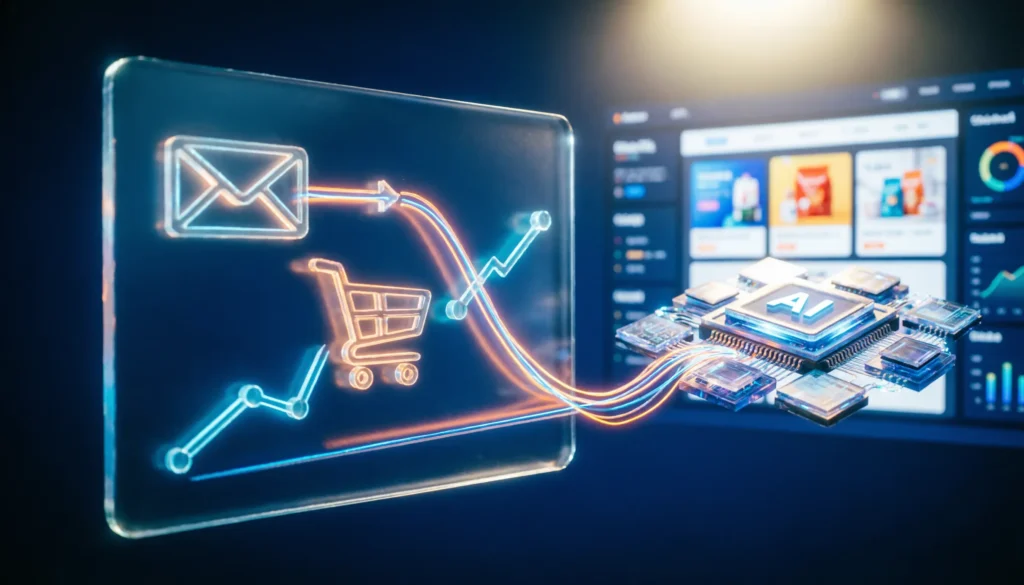
| Quick Answer Ecommerce email marketing uses targeted email campaigns to drive online store revenue through welcome sequences, abandoned cart recovery, post-purchase flows, promotional campaigns, and win-back emails. Email generates $36 to $42 for every $1 spent, making it the highest-ROI marketing channel available to ecommerce businesses. A well-built email program should generate 20 to 25% of total store revenue. |
Most ecommerce businesses underinvest in email while overspending on paid ads. This is one of the most common and expensive mistakes in online retail. Paid ads stop the moment you stop paying. Email, when built correctly, keeps generating revenue around the clock from a list you own.
You do not need a massive list to make email work. You need the right sequences, the right segmentation, and a consistent sending cadence. This guide gives you the practical framework to understand and execute ecommerce email marketing regardless of the size of your store.
Table of Contents
Why Email Marketing Is Non-Negotiable for Ecommerce
The ROI case is straightforward. Email consistently delivers $36 to $42 in revenue for every $1 spent. No other digital channel comes close to that ratio. Social media advertising can achieve great returns, but it requires ongoing spend and creative resources. SEO takes months. Email works while you sleep.
The second reason is ownership. Your email list belongs to you. Your Instagram followers, Facebook fans, and TikTok audience sit on platforms that can change their algorithm, restrict your reach, or disappear entirely. Your email list does not. That is a business asset, not a rented audience.
Industry benchmarks suggest that 20 to 25% of total ecommerce revenue should be generated by SMS and email marketing combined. If your store is below that range, there is money on the table.
The 6 Core Ecommerce Email Types Every Store Needs
- Welcome series: A 3-email sequence sent to every new subscriber. Introduce your brand, share your story, present your bestsellers, and include a first-purchase incentive. This sequence sets the tone for the entire customer relationship.
- Abandoned cart recovery: Sent to users who add products to their cart but do not complete the purchase. A 3-email sequence sent at 1 hour, 24 hours, and 72 hours typically recovers 5 to 15% of abandoned carts. This is the highest-ROI automation for most stores.
- Post-purchase sequence: Order confirmation, shipping notification, delivery confirmation, and a review request sent 7 to 14 days after delivery. This sequence reduces customer service inquiries and generates social proof automatically.
- Promotional campaigns: Planned broadcast emails for sales, new product launches, seasonal events, and brand announcements. These should be segmented by purchase history and engagement level to avoid sending irrelevant content to your entire list.
- Win-back emails: Targeted at customers who have not purchased in 90 to 180 days. A well-timed offer combined with a personal tone reactivates a meaningful percentage of lapsed buyers.
- Browse abandonment: Triggered when a logged-in user views a product page but does not add it to their cart. Gentler than cart abandonment emails, but still effective for high-consideration products.
How to Build Your Email List the Right Way
List quality matters more than list size. A list of 5,000 engaged subscribers will outperform a purchased list of 50,000 unverified contacts every time.
- On-site popups: Triggered after 180 seconds of active browsing or after 8 scroll events, not immediately on page load. Immediate popups annoy visitors before they have seen anything.
- First-purchase discount: Offering 10 to 15% off in exchange for an email address is the most common and most effective list-building tactic for ecommerce.
- Checkout opt-in: Add a clearly visible checkbox at checkout. It should be opt-in, not pre-checked, to keep your list compliant and engaged.
- Post-purchase: Ask customers who purchase without subscribing to join your list. They are already engaged with your brand.
Never buy an email list. Purchased lists damage your sender reputation, inflate your bounce rate, and put your domain at risk of being blacklisted by major email providers.
Segmentation and Personalization
Sending the same email to your entire list is one of the fastest ways to tank your open rates and revenue per subscriber. Effective ecommerce email marketing uses segmentation to send the right message to the right person at the right time.
Core segments every ecommerce store should maintain:
- First-time buyers vs. repeat buyers
- High-value customers (top 20% by lifetime value)
- Product category buyers (if you sell across multiple categories)
- Engaged subscribers (opened in last 90 days) vs. disengaged subscribers
- Geographic segments if you have region-specific promotions
Platforms like Klaviyo, Omnisend, and Drip make this level of segmentation achievable for stores of any size.
Key Metrics to Track
| Metric | What ‘Good’ Looks Like for Ecommerce |
| Open rate | 35 to 50% for automated flows; 20 to 35% for broadcast campaigns |
| Click rate | 3 to 8% depending on campaign type |
| Conversion rate | 1 to 5% for promotional emails |
| Revenue per email sent | Varies by product price; track trends over time |
| List growth rate | Positive month-over-month net growth |
| Unsubscribe rate | Below 0.5% per campaign is healthy |
Common Mistakes Ecommerce Store Owners Make
- No automated flows in place: Sending only broadcast campaigns means you are leaving abandoned cart recovery and post-purchase revenue on the table every single day.
- Sending to the full list every time: Emailing every subscriber about every campaign burns out your list and inflates your unsubscribe rate. Segmentation preserves list health.
- Too many discount emails: Training customers to wait for a promo code before buying destroys your margin and conditions buyers to never pay full price.
- Ignoring mobile design: Over 60% of emails are opened on a mobile device. If your template is not mobile-first, your conversion rate will suffer regardless of how good your copy is.
How Torplix Helps With Ecommerce Email Marketing
At Torplix, we build ecommerce email programs from the ground up: list segmentation, automated flow setup, campaign strategy, and monthly performance reporting. We work with platforms including Klaviyo and Omnisend to ensure your program is set up to generate revenue, not just sends.
Visit our Email Marketing page to learn more about how we approach it.
Frequently Asked Questions
-
What is ecommerce email marketing?
Ecommerce email marketing is the use of targeted email campaigns to drive sales and customer retention for online stores. It includes automated flows (welcome, abandoned cart, post-purchase) and broadcast campaigns (promotions, launches, seasonal offers).
-
How often should an ecommerce store send emails?
Automated flows send based on customer behavior, not a schedule. For broadcast campaigns, 1 to 3 per week is typical for active stores. Start at 1 to 2 per week and scale up as you build list trust and segment properly.
-
What email flows does every ecommerce store need?
The four non-negotiable flows are: welcome series, abandoned cart recovery, post-purchase sequence, and win-back campaign. These four flows alone can generate 15 to 25% of total email revenue with minimal ongoing management once built.
-
What is a good email open rate for ecommerce?
Automated flows like welcome and abandoned cart emails typically achieve 40 to 60% open rates. Broadcast promotional campaigns average 20 to 35%. If your open rates are consistently below 15%, it usually signals a deliverability issue or an unengaged list.