
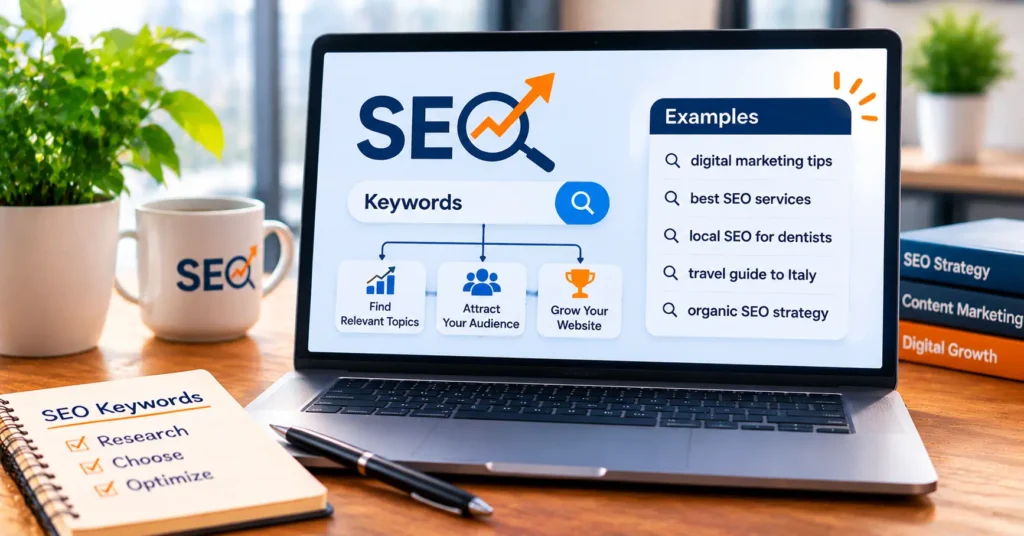
SEO keywords are the words and phrases people type into a search engine, and the words you use on your pages so those searches can lead to you. If someone searches for “emergency plumber in Leeds”, that phrase is a keyword, and a plumber who wants those customers uses it, or close variations of it, on the right page.
This guide explains what SEO keywords are, the different types, how to find good ones, where to use them and what to avoid. It is written for beginners and uses Google’s own documentation wherever it can.
SEO keywords are the words and phrases that people search for and that your pages should be about. They are not a list to repeat on a page. Google’s SEO Starter Guide advises you to think about the words a user might search for to find your content, and warns that repeating the same words over and over is tiring for readers. Pick keywords that match what your customers want, then write a clear, useful page about that topic.
Table of contents
- What SEO keywords are
- An example
- Types of keyword
- Search intent
- How to find keywords
- Keyword numbers explained
- How to choose good keywords
- A research walk through
- Where to use keywords
- Matching keywords to pages
- Keywords for different types of site
- Keywords and AI search
- Mistakes to avoid
- How to check your keywords are working
- How to learn more
- FAQ
- Where to start
What SEO keywords are
A keyword, in SEO, is a topic described by the words people use to search for it. Despite the name, it is often a phrase of several words, and it can be a question. The same idea is also called a search term or a query.
Keywords matter because they connect two things: what people want and what your pages offer. If your page is about something people search for, and it uses the words they use, search engines can understand it and show it to the right people. If your page uses different words from your customers, it may never be found, however good it is.
Keywords are not the old meta tag
You may see advice to fill in a “keywords” box on your site. Google’s page on supported meta tags says the meta keyword tag is not used by Google Search and has no effect on indexing and ranking at all. When people talk about SEO keywords today, they mean the words that pages are about, and the words that appear on them.
An example
This example is made up. Imagine a bakery in Bristol that makes wedding cakes. Here is how people might search for it, and what each search suggests.
| Search (example) | What the person probably wants | The right page |
|---|---|---|
| wedding cake ideas | Inspiration, not ready to buy | A blog post or gallery |
| how much does a wedding cake cost | Prices, comparing options | A guide with price ranges |
| wedding cake bakery bristol | To find a local supplier | The wedding cakes page |
| order a wedding cake | Ready to buy or enquire | The enquiry or booking page |
All four searches are about wedding cakes, but each needs a different page. That is why picking keywords is about understanding people, not just collecting words.
Types of keyword
Keywords are grouped in different ways. Two are especially useful to beginners.
By length
- Short keywords have one or two words, such as “wedding cakes”. They are broad, searched often and hard to rank for.
- Long keywords, often called long tail, have three or more words, such as “gluten free wedding cake bristol”. Fewer people search for them, but the searches are specific and often closer to a purchase.
Beginners and small businesses usually get further with long keywords, because there is less competition and the intent is clearer.
By intent
The same word can mean different things, so it helps to group by what the person is trying to do. The next section covers this.
By place
Local keywords include a place, such as “dentist in Leeds”, or imply one, as with “dentist near me”. For these, your Google Business Profile matters too. See our guide to what local SEO is.
By brand
Branded keywords include a company or product name. People who search for your name already know you. Non-branded keywords are the generic terms that bring in people who do not.
Search intent
Search intent is the reason behind a search. Matching it is more important than repeating a keyword, because a page that does not give people what they want will not hold their attention or rank well.
| Intent | Example search | What to offer |
|---|---|---|
| Informational | what are seo keywords | A clear explanation or guide |
| Navigational | torplix contact | The page they are looking for |
| Commercial | best email software for small business | A comparison or review |
| Transactional | buy running shoes size 9 | A product or booking page |
How to check intent
Search for your keyword and look at what Google shows. If the results are mostly guides, a guide is what people want. If they are product pages, a guide will struggle. The results page is the best clue to what a keyword needs.
How to find keywords
You do not need expensive tools to start. Work through these in order.
- Start with your customers. Write down the questions they ask, the words they use and the problems they describe. Use the words they use, not your industry’s words.
- Look at your own search data. Google’s Search Console performance report lists the queries that already bring people to your site, with clicks and impressions. It is free and shows real data.
- Use Google’s suggestions. Type your topic into Google and look at the autocomplete suggestions, the “People also ask” questions and the related searches at the bottom of the page.
- Look at competitors. See what pages rank for your topics and what each page covers.
- Use a keyword tool if you want estimates. Free and paid tools give estimated search volumes and difficulty. Treat the numbers as rough guides.
- Group the results. Put similar keywords together, because one page can often cover several.
Questions are keywords too
Many searches are questions: “how do I”, “what is”, “can I”. These make good headings and short answers on a page, and they are often how people reach a site by voice or through AI answers.
Keyword numbers explained
Keyword tools show several numbers. They are useful as rough guides, but none of them is exact, and different tools can give different figures for the same keyword.
Search volume
An estimate of how many times a phrase is searched in a month. A high number means more interest, but also more competition. A low number can still be valuable if the searchers are close to buying.
Keyword difficulty
A score that tries to show how hard it is to rank. Each tool calculates it differently, so compare keywords within one tool, not across tools.
Cost per click
What advertisers pay for a click on that phrase in ads. A high figure often means the search has commercial value, which can help you judge which topics matter.
Your own data
The most reliable numbers are the ones from your own site. Search Console shows the real impressions and clicks that your pages get, which tools can only estimate.
How to choose good keywords
“Good” depends on your business. Score each keyword on four things.
- Relevance. Does it describe something you really offer?
- Intent. Is the person likely to want what you can give them?
- Difficulty. Can a site like yours realistically compete? New sites do better with specific phrases.
- Value. Would a visitor from this search be worth having, as a customer, a lead or a reader you want?
A keyword with a small search volume that is exactly what your customers want is often better than a large one that is only loosely related. Volume is a number from a tool, while relevance is something you can judge yourself.
Good keywords for SEO: a short test
Ask three questions. Would I be happy if this person landed on my page? Can I answer what they want better than what ranks now? Does the answer move my business forward? If the answer to all three is yes, it is a good keyword for you.
A research walk through: an example
Here is how the steps fit together, using the made up bakery from earlier.
- List the offers. Wedding cakes, birthday cakes, cupcakes for events and gluten free cakes.
- Write the customers’ questions. “How far ahead should I order a wedding cake?”, “Do you deliver?”, “Can you make a vegan cake?”
- Check Google’s suggestions. Type “wedding cake bristol” and note the autocomplete options and the “People also ask” questions.
- Check the results. See whether pages are local bakeries, galleries or price guides, and what they cover.
- Group the phrases. Put local supplier searches on the wedding cakes page and price questions on a separate guide.
- Pick the main keyword for each page. Choose the clearest phrase, and write the related ones in as natural headings and answers.
The whole exercise takes an afternoon, needs no paid tool, and gives the business a plan for which pages to write or improve.
Where to use keywords
Once you have a main topic for a page, use its words naturally in the places where people and search engines look.
- Title. Google says a good title is unique to the page, clear and concise, and accurately describes the page.
- Main heading. One clear heading that says what the page is about.
- Sub headings. Questions and topics that people search for, in plain words.
- The first paragraph. Say what the page covers early, in normal language.
- The body. Cover the topic fully, using the related words people use, not one phrase on repeat.
- Image descriptions. Describe what the image shows, accurately.
- Links. Use descriptive link text to related pages.
- Meta description. Google says it may be used in the snippet in some situations, so write it as a short summary.
Google’s guide also says that the keywords in a domain name or URL alone have hardly any effect. Do not rename a site only to include a phrase. Our on page SEO service explains how we handle titles, headings and copy.
Matching keywords to pages
The simplest rule is one main topic per page. Give every page a main keyword and a few related ones, and make sure no two pages are competing for the same search.
| Page (example) | Main keyword | Related keywords |
|---|---|---|
| Wedding cakes | wedding cake bakery bristol | custom wedding cakes, bristol wedding cake maker |
| Wedding cake prices guide | how much does a wedding cake cost | wedding cake price per slice, average wedding cake cost |
| Gluten free cakes | gluten free wedding cake | gluten free celebration cake, allergy friendly cakes |
If you find two pages aimed at the same keyword, merge them or give each a different job. It is easier for readers and for search engines.
Keywords for different types of site
The method is the same everywhere, but the emphasis changes.
Local businesses
Include the place, and pay attention to your Google Business Profile as well as your pages. Searches such as “near me” depend on where the person is.
Online stores
Product and category pages need their own keywords, and filters can create many near duplicate pages. See our ecommerce SEO service for how this is handled.
B2B companies
Buyers research for a long time, so cover questions at different stages, not only the final “hire” search. Our B2B SEO services page covers this.
Blogs and publishers
Start with the questions your readers ask and build topic groups, so related articles link to one another.
Keywords and AI search
People now ask AI tools the same questions they used to type into search boxes, often in full sentences. Google’s page on AI features and your website says the best practices for SEO remain relevant, and that no special optimizations are necessary. So the advice here still applies: understand the question, answer it clearly, and use the words people use.
Mistakes to avoid
- Keyword stuffing. Google’s spam policies describe keyword stuffing as filling a page with keywords or numbers in an attempt to manipulate rankings. It makes pages worse to read and can hurt you.
- Chasing volume only. A big number does not mean the right visitors.
- Ignoring intent. A sales page for an informational search will not satisfy people.
- Targeting words you cannot rank for yet. Start with narrower phrases and build up.
- Using words your customers do not. Jargon may be accurate and still be useless.
- Doing the research once. Language, trends and your business change, so review keywords each year.
- Forgetting to check results. Without checking, you will not know what works.
How to check your keywords are working
Return to Search Console after a few weeks. Look for the queries a page now appears for, its impressions and clicks, and its average position. Rising impressions for the right queries are a good early sign. Results can differ from what you see when you search yourself, because search results depend on time, location, device and history.
Pair that with business numbers: enquiries, orders and calls. A page that ranks well for a keyword but brings no customers is telling you that the keyword or the page needs a rethink.
How to learn more
You can learn the basics of SEO yourself with a few good sources and some practice.
- Read Google’s SEO Starter Guide. It is free and written by the search engine itself.
- Use Search Console on your own site. Real data teaches faster than theory.
- Practise on one page. Pick a topic, research it, write the page and watch what happens.
- Read our guides. Our SEO guide covers the wider subject.
SEO keywords FAQ
What is a keyword in SEO, with an example?
It is a word or phrase that people search for and that a page is written to answer. For example, a bakery might target “wedding cake bakery in Bristol” on its wedding cakes page.
How do I learn SEO as a beginner?
Start with Google’s SEO Starter Guide, then apply it to a small site of your own. Use Search Console to see what happens, and change one thing at a time.
Can I do SEO myself?
Yes. Researching keywords, writing clear pages and checking Search Console need care and time, not special skills. Help makes sense when the site is large or technical, the market is crowded or you are short of time.
What are good keywords for SEO?
Good keywords describe something you offer, match what searchers want and are realistic for your site to rank for. They are specific enough to bring the right people.
How many keywords should I use on a page?
There is no number. Choose one main topic and write about it fully, using related words naturally. Do not count repetitions.
Are keywords still important?
Yes, but as topics, not as a count of repeated words. Search engines understand related phrases and meaning, so a page that covers a subject well does not need the exact phrase again and again.
Should I use the exact keyword every time?
No. Use the main phrase where it reads naturally, and let related words and variations appear as you explain the topic. If a sentence sounds odd to read aloud, rewrite it.
Do I need a paid tool?
Not to begin with. Your own customers, Search Console and Google’s suggestions give you plenty to work with. A paid tool can help later, when you manage many pages.
How often should I review my keywords?
Look at them at least once a year, and after any big change to your business or site. Search habits shift, new questions appear and some phrases lose interest, so a short review keeps your pages aligned with what people want.
Where to start
Pick one page that matters, such as your main service page. Write down what a customer would type to find it, check what Google shows for that search and note the questions in “People also ask”. Then make sure the page answers them clearly, in the words your customers use.
If you want a second opinion, Torplix offers a free audit of your site, with a written list of fixes in priority order. It is yours to keep whether or not you work with us, and we do not promise rankings. See our SEO services for how we work.