
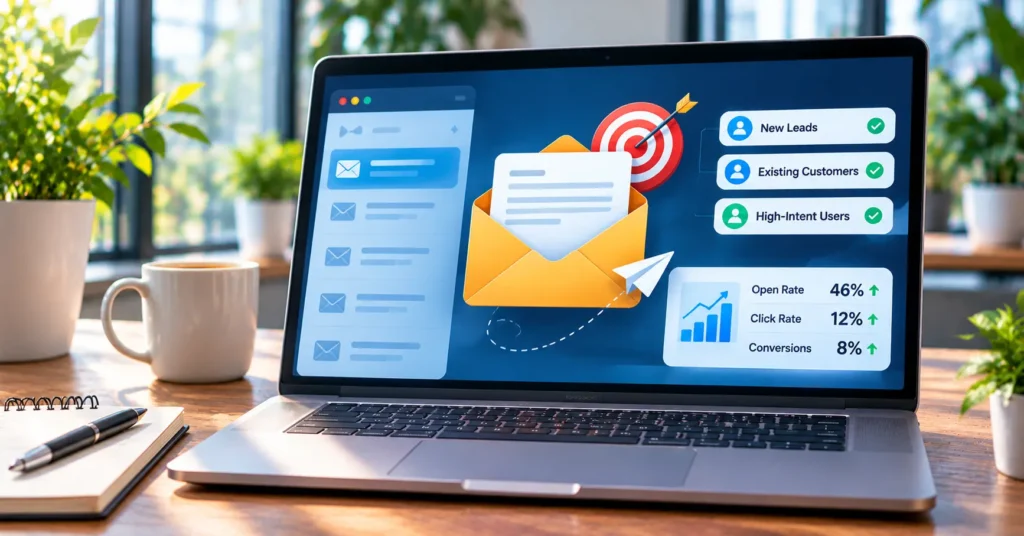
Targeted email marketing means sending different emails to different groups of people on your list, based on who they are or what they have done, instead of sending the same message to everyone. A shopper who bought last week and a subscriber who has not opened an email in six months need different messages, and targeting lets you send each one the right thing.
This guide explains what targeted email marketing is, how to build segments, the campaigns that work well, the rules you must follow and how to measure the results. It is written for owners and marketers who already have a list or are about to build one.
Targeted email marketing is the practice of splitting your list into groups, called segments, and sending each group a message that fits it. You can segment by who people are, what they have bought or viewed, how engaged they are and where they are in their relationship with you. It needs a good reason to email each group, accurate data and permission to send. In the US, the CAN-SPAM rules apply to commercial email, and other countries have their own.
Table of contents
What targeted email marketing is
An email newsletter that goes to every subscriber is a broadcast. A targeted email is aimed at a smaller group chosen for a reason. The reason might be a purchase, a page someone viewed, a date, a job title or the time since they last opened an email.
Targeting is also called segmentation. You can do it by hand with a spreadsheet, or with the features built into most email tools, which can sort people into groups and send automatically when someone joins a group.
Targeted, personalised and triggered
These words overlap, but they are not the same. Targeted means sending to a chosen group. Personalised means adding details such as a name or a product that a person looked at. Triggered means sending automatically after an action, such as a welcome email after sign up. Good programmes use all three.
Why target your emails
The reason is simple: a message that fits is more likely to be useful, and a useful message is less likely to be ignored, deleted or marked as spam.
- Relevance. People get information that suits them, not offers they cannot use.
- Fewer unsubscribes. People tend to leave when emails feel irrelevant or too frequent.
- Better use of your list. You can email engaged people often and give others a quieter schedule.
- Clearer learning. Smaller groups make it easier to see what works.
- Timeliness. Triggered emails reach people when they are thinking about you.
Targeting does not fix a poor offer or a poor product. It makes good emails more useful to the right people.
Ways to segment your list
Start with the data you already have. You do not need dozens of segments, and a few clear ones usually beat many complicated ones.
| Segment by | Examples | Good for |
|---|---|---|
| Who they are | Location, language, job role, company size | Local events, role specific content in B2B |
| What they bought | First time buyer, repeat buyer, product category | Follow ups, cross sells, refills |
| What they did | Viewed a product, left a basket, downloaded a guide | Reminders and related content |
| How engaged they are | Opened in the last 30 days, not opened in 6 months | Frequency and win back emails |
| Where they came from | Sign up form, event, partner, social | Welcome messages that match the source |
| What they told you | Topics chosen, frequency chosen, birthday | Preference based emails |
Ask people what they want
The best data is what people tell you. A short sign up form, or a preference page that lets people choose topics and how often they hear from you, gives you permission and useful information at the same time.
Do not guess about sensitive things
Be careful with data about health, money, children or other sensitive subjects. Use only what people have chosen to share and are happy for you to use.
Targeted email campaigns that work
These are common campaigns that suit most businesses. You do not need all of them.
Welcome series
A short set of emails after someone signs up, introducing who you are and what to expect. It is often the most read email you send, so it is worth getting right.
Abandoned basket or quote
A reminder sent when someone starts a purchase or a form and does not finish. Keep it helpful: show the item or answer a likely worry, instead of pushing.
Post purchase
A thank you, delivery details, how to use the product and, later, a request for a review. Our guide to ecommerce email marketing goes into these flows.
Win back
An email to people who have gone quiet, with a reason to return or a choice to stay or go. If they do not respond, stop emailing them.
Education for leads
For businesses with a longer buying process, a series of emails that answers common questions in order. Our guide to B2B email marketing covers this.
Events and dates
Invitations, reminders and follow ups tied to an event, a birthday, a renewal date or a season.
A segment plan: an example
This plan is made up, to show how the pieces fit. It is not a result from any business. Imagine a small online shop that sells coffee beans and has about 5,000 subscribers.
| Segment (example) | How people get in | What they receive |
|---|---|---|
| New subscribers | Joined in the last 14 days | A three email welcome series |
| First time buyers | One order, no repeat | A how to brew guide, then a reorder reminder at a suitable time |
| Regular customers | Three or more orders | Early access to new beans, no discounts |
| Browsed, did not buy | Viewed a product page in the last 7 days | One reminder with tasting notes |
| Quiet subscribers | No opens in six months | A “still want these?” email, then removal |
Each segment has a clear rule for who is in it, a purpose, and a stopping point. That is the test of a good segment: you can say who is in it, what you want to happen and when to stop.
How to get started
- Pick one goal. For example, more repeat orders or more booked calls.
- Look at your data. Find out what you know about people, and how reliable it is.
- Choose two or three segments. Start small, with groups that are easy to define.
- Write for each group. Say why they are receiving the email and what they can do next.
- Set up the automation. Use your email tool’s rules so people enter and leave a segment on their own.
- Send and watch. Check clicks, replies, unsubscribes and the business result after a few weeks.
- Improve one thing at a time. Change a subject line, an offer or a send time, and compare.
If you would like help with the set up, our email marketing service covers planning, writing and reporting.
Getting and keeping the data
Targeting is only as good as the information behind it.
- Collect only what you need. Every extra form field lowers sign ups.
- Connect your tools. Link your shop, forms and email tool, so purchases and actions update the list.
- Keep it clean. Remove addresses that bounce, merge duplicates and fix obvious typos.
- Update preferences. Let people change their choices, and respect them straight away.
- Never buy a list. People who did not agree to hear from you will ignore or report you, and it may also break the law.
The rules: consent and opt-outs
Email marketing is regulated, and targeted emails are not exempt. These are the headline points for the US and UK. They are general information, not legal advice, and the rules vary by country and are updated from time to time.
United States
The FTC’s CAN-SPAM compliance guide, linked above, says, in summary, that you must not use false or misleading header information or deceptive subject lines, you must identify the message as an ad, include your valid physical postal address and tell people how to opt out. It says you must honor an opt-out request within 10 business days, and that you cannot contract away your legal responsibility if you hire another company to send for you.
United Kingdom
The ICO’s guide to electronic mail marketing says you must not send marketing emails to individuals without specific consent. It describes a limited exception, called the soft opt-in, for existing customers who bought a similar product or service and were given a clear chance to opt out, and it says an opt-out must be offered in every message. The ICO notes that its guidance is under review following changes in the law.
Elsewhere
The EU, Canada, Australia and other markets have their own requirements, and they can be stricter. If you email people in several countries, check the rules for each, or follow the strictest.
How to measure results
Judge each segment by the outcome you chose at the start, not only by opens.
- Clicks and replies. They show interest more reliably than opens.
- Conversions. Orders, bookings, sign ups or calls that came from the email.
- Revenue or value per email. Useful for comparing segments of different sizes.
- Unsubscribes and complaints. A rise means the targeting or the frequency is off.
- List growth and health. New sign ups, bounces and the share of quiet subscribers.
Open rates can be unreliable, because some mail apps load images automatically and make it look as if a message was opened. Use them as a rough signal, not as proof of interest.
Common mistakes
- Too many segments. If you cannot write a different email for each, you have too many.
- Weak rules for who is in a group. People end up receiving the wrong thing.
- Creepy personalisation. Using details people did not expect you to know can put them off.
- Emailing everyone anyway. A segment you never use is just a spreadsheet.
- No stopping rule. Keep emailing people who never respond and you will harm your sender reputation.
- Forgetting the opt-out. It is a legal requirement and a mark of trust.
Targeted email marketing FAQ
What is a targeted email?
It is an email sent to a specific group of people chosen for a reason, such as a recent purchase or an interest, instead of to the whole list.
What are the four main types of email marketing?
There is no official list. A common grouping is newsletters, promotional emails, transactional emails such as receipts, and automated lifecycle emails such as welcome series. Targeting applies to all of them.
What is the 80/20 rule in email marketing?
It is a rule of thumb, not a measured law, and people use it in different ways. One version says about 80% of your results often come from about 20% of your list. Another says 80% of your content should be useful and 20% promotional. Check both against your own numbers.
What does targeted marketing mean?
It means aiming your message at a defined group of people who are most likely to want it, instead of at everyone. Targeted email marketing applies the idea to your email list.
How many segments do I need?
Start with two or three. Add another only when you have a clear reason and the time to write for it.
Is it legal to email people I met at an event?
It depends on the country and on what they agreed to. Handing over a business card is not always the same as agreeing to marketing emails. Check the rules for your market and keep a record of consent.
Where to start
Pick the one group that matters most, such as new subscribers or first time buyers, and write a short series of emails just for them. Check that you have permission to email them, set up the automation and look at the results after a month.
If you want a second opinion, Torplix offers a free audit of your email set up, with a written list of fixes in priority order. It is yours to keep whether or not you work with us, and we do not promise results. See our email marketing service for how we work.