
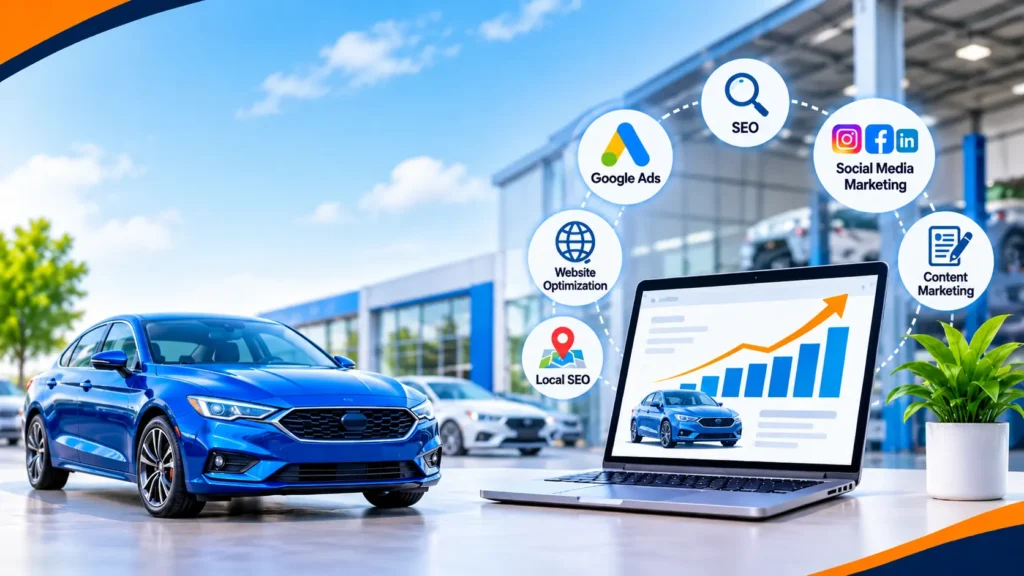
Automotive digital marketing is the use of online channels to attract car buyers and service customers: search, maps, websites, ads, reviews, email and social media. It covers car dealerships, independent repair shops, tyre and parts sellers, body shops and other businesses that sell vehicles, parts or car care.
This guide explains how people find automotive businesses online, which channels matter, how to set up your Google profile and website, how reviews and ads fit in, which rules apply and how to measure results. It is written for owners and managers, and it avoids promises about results.
Automotive digital marketing means being easy to find and easy to trust when someone searches for a car, a repair or a part. Start with your Google Business Profile and website, because most local searches begin there. Google says local results are based mainly on relevance, distance and prominence, so keep your details complete, ask for reviews and give each service its own clear page. Add ads and email once the basics work.
Table of contents
- What automotive digital marketing is
- How people find automotive businesses
- The main channels
- Your Google Business Profile
- Your website
- Reviews and reputation
- Paid search and ads
- Email, text and follow up
- Marketing for dealerships
- Marketing for repair shops
- Content ideas that help customers
- Advertising rules
- How to measure it
- Three examples
- A 90 day plan
- Common mistakes
- Automotive digital marketing FAQ
- Where to start
What automotive digital marketing is
It is the same discipline as any local business marketing, with some features that belong to the industry. Purchases are large and infrequent for car buyers, but frequent for service customers. Inventory changes daily, prices vary, and trust matters a great deal when someone is spending thousands on a car or handing over the keys for a repair.
Who it is for
- New and used car dealerships. They sell vehicles and often run service and parts departments.
- Independent repair shops. They depend on local searches and repeat customers.
- Tyre, glass, body and detailing businesses. They serve people with an immediate need.
- Parts sellers and aftermarket brands. They sell through shops, retailers or online.
- Specialists. Electric vehicle chargers, fleet services, classic cars and motorcycles.
The channels are largely the same, but the emphasis differs. A dealership leans on inventory pages and lead follow up, while a repair shop leans on maps, reviews and appointment booking.
How people find automotive businesses
Buyers and service customers use search in different ways, and your marketing should meet both.
| Customer | Typical search (example) | What they need to see |
|---|---|---|
| Car shopper | used SUVs in [town] | Current stock, clear prices, photos and a way to book a visit |
| Researching buyer | best family car for a long commute | Helpful guides and comparisons |
| Service customer | brake repair near me | Hours, reviews, services and a phone number |
| Emergency | tyre puncture repair open now | Whether you are open and can help now |
| Parts buyer | [part] for [model] | Fit information, stock and delivery |
| Loyal customer | [your business name] | Your website and profile, with accurate details |
Many of these searches are local, and many happen on a phone. A clear, fast site and an accurate profile make the difference between a call and a competitor.
The main channels
- Local search and maps. Your Google Business Profile and local pages. Our guide to what local SEO is explains the basics.
- Your website. The place where inventory, services, prices and bookings live.
- Organic search. Pages that answer questions and match what people search for. See our SEO services.
- Paid search. Ads for high intent searches such as “brake repair near me”.
- Reviews. What past customers say about you.
- Email and text. Reminders, offers and follow up.
- Social media and video. Showing stock, work and the people behind the business.
- Listing sites. Third party sites where vehicles and shops are listed. Keep them accurate.
You do not need all of them at once. Choose the ones closest to the customers you want, and do them well.
Your Google Business Profile
For most automotive businesses, the profile is the most important free marketing asset. It shows on the map, in the search panel and on mobile.
Know the rules for your type of business
Google’s Business Profile guidelines say that auto dealers have specific and separate guidelines, so read them before you set up or change a profile. They also say that publicly facing departments that operate as distinct entities should have their own page, with their own name and category. Their example is a main dealer listed as a dealer, with its service and parts department listed separately as an auto repair shop.
Fill it in properly
- Use your real name. Do not add keywords to the name.
- Choose accurate categories. The main category should describe your core business.
- Keep hours exact. Include holiday hours and any different hours for service and sales.
- List services. Repairs, inspections, tyres, detailing, or the types of vehicles you sell.
- Add real photos. The lot, the workshop, the team and the customer area.
- Link to booking pages. Send people to the right place for an appointment or a quote.
- Use the right phone number. One that is answered, with sales and service separated if needed.
Our guide to citation SEO explains how to keep your details consistent across directories and listing sites.
Your website
The website turns interest into action. For automotive businesses, a few things matter more than design.
- Speed on a phone. People search while they are out, and slow pages lose them.
- Tap to call and easy booking. A visible phone number and a short booking form.
- A page for each service. Brake repair, oil changes, tyres, air conditioning and so on, each with its own page and a clear explanation.
- Clear prices or price ranges. Where you can, say what a job typically involves and what affects the price.
- Trust signals. Qualifications, warranty terms, brands you work with and real customer photos.
- Location information. Address, map, parking and opening hours on every page that needs them.
Inventory pages for dealers
Each vehicle should have its own page with a unique address, photos, price, mileage, specifications and a way to enquire. Remove or redirect pages for vehicles that have sold, and avoid copying manufacturer text word for word, because many dealers use the same text.
Reviews and reputation
Reviews matter a lot in the automotive world, because customers worry about being overcharged or sold a poor car. Google’s page on managing customer reviews says replying shows customers you value their feedback, and that the reviewer is notified when you reply.
- Ask at the right time. For service, ask when the customer collects the car. For sales, ask after the first weeks of ownership.
- Make it easy. Send a text or email with a direct link.
- Reply to every review. Thank people, and respond calmly to complaints.
- Take problems offline. Offer a phone number or email to fix them.
- Do not write or buy reviews. It breaks platform rules and customers can tell.
Paid search and ads
Ads suit businesses that need customers quickly or want to cover searches where they do not yet rank. They work best for high intent searches, such as an emergency repair or a specific vehicle.
- Target by location. Limit ads to the area you serve.
- Match the ad to the search. “Brake repair” ads should lead to a brake repair page.
- Track calls and bookings. Count what happens after the click.
- Control the budget. Start small and increase only when results justify it.
- Review search terms. Block searches that waste money, such as job seekers or unrelated parts.
Our Google Ads management service explains how we set up and run search campaigns.
Email, text and follow up
Many sales and service bookings happen after a second or third contact. Follow up turns a single enquiry into a customer.
- Answer enquiries quickly. A fast reply often decides who gets the visit.
- Send service reminders. Based on the time or mileage since the last visit.
- Follow up quotes. A short message a few days later.
- Keep in touch with past buyers. Occasional useful messages, such as seasonal checks.
- Respect consent. Only message people who agreed to hear from you, and make opting out easy.
See our email marketing service for how reminders and campaigns can be planned.
Marketing for dealerships
Dealerships have extra things to manage: large inventory, financing, trade-ins and several departments.
- Keep inventory fresh. Out of date listings damage trust.
- Be clear about price. Show what is included and what is extra.
- Explain financing and trade-in options. In plain words, with a clear way to ask.
- Separate departments properly. Sales, service and parts each need accurate listings and phone numbers.
- Measure leads by source. Know which channels bring appointments and sales, not just enquiries.
Marketing for repair shops
Repair shops live on trust and location. Customers often choose the nearest shop with good reviews.
- Be easy to book. Offer online booking or a clear phone number.
- Explain the work. Pages and short posts on common problems help people understand and trust you.
- Show your people. Photos of the team and workshop make a small business feel real.
- Win repeat business. Reminders and a good experience matter more than one big campaign.
- Be clear about warranties. What is covered, for how long, and how to claim.
Content ideas that help customers
You do not need a large blog. A handful of clear pages that answer the questions customers ask can do more than a stream of general posts.
- Service explainers. What a brake service involves, how long it takes and what affects the price.
- Warning signs. Noises, lights and symptoms that mean a car needs attention, with plain advice on what to do next.
- Seasonal checks. Winter tyres, summer air conditioning and what to check before a long trip.
- Buyer guides. How to choose between body types, new and used, or petrol and electric, written for local buyers.
- Ownership help. Servicing schedules, warranty basics and what to do after an accident.
- Behind the scenes. Short posts or videos of the workshop and team, which make a business easier to trust.
Write in plain words, keep the facts accurate and link each piece to the service or vehicle page it relates to.
Advertising rules
Automotive advertising is regulated, and the rules differ by country and region. In the US, the Federal Trade Commission publishes business guidance for the auto industry, with resources on digital disclosures, advertising consumer leases, truth in advertising for small business and pricing transparency.
- Be accurate about prices and offers. Include the conditions that matter, in a place customers can see.
- Make disclosures clear. Important terms should not be hidden in small print.
- Follow local rules. States, provinces and countries have their own requirements for vehicle sales, finance and repair estimates.
- Handle data properly. Customer details and consent are covered by privacy law.
This is general information, not legal advice. Check the rules for your market with your trade body, regulator or adviser.
How to measure it
Count what matters to the business, not only clicks.
- Calls. Track calls from your profile, website and ads.
- Appointments and visits. Service bookings and showroom visits.
- Enquiries by source. Which channels bring real customers.
- Sales and repair orders. Match marketing to what was sold or fixed.
- Reviews. New reviews and your average rating.
- Cost per lead and per sale. Compare channels fairly.
Ask new customers how they found you and log the answers. It is simple and often uncovers channels that tracking misses.
Three examples
These examples are made up, to show how the ideas fit together. They are not results from any business.
An independent repair shop
The shop completes its profile, adds a page for each main service, makes the phone number tappable and asks every customer for a review when they collect the car. It sends a service reminder six months later.
A used car dealer
The dealer gives each vehicle a page with photos and honest descriptions, removes sold cars quickly, answers enquiries within the hour and tracks which listings bring visits.
A tyre and wheel shop
The shop runs a small search campaign for “tyre repair near me” during opening hours, sends searchers to a page with prices and booking, and measures calls.
A 90 day plan
Days 1 to 30: fix the basics
- Claim and complete your Google Business Profile, with departments set up correctly.
- Check your name, address and phone number across listings.
- Set up call and form tracking.
- Check your site on a phone, and fix speed and booking problems.
Days 31 to 60: build pages and reviews
- Write a clear page for each main service or vehicle type.
- Start asking every customer for a review, and reply to the ones you have.
- Set up simple email or text reminders.
Days 61 to 90: add reach and review
- Test a small search campaign for your best services.
- Review calls, bookings and sales by source.
- Decide what to keep, drop or expand.
Common mistakes
- An incomplete or duplicate profile. It confuses customers and search engines.
- Slow or hard to use mobile sites. Many searches are on phones.
- Out of date inventory or prices. It costs trust and wastes visits.
- Ignoring reviews. Unanswered complaints put people off.
- Slow replies to enquiries. A fast answer wins the visit.
- Paying for leads you cannot track. Count calls and sales, not only clicks.
- Hiding terms in small print. It can break advertising rules and anger customers.
Automotive digital marketing FAQ
What is automotive digital marketing?
It is marketing online for businesses that sell vehicles, parts or car services. It uses search, maps, websites, ads, reviews, email and social media to attract and keep customers.
What is the 3-3-3 rule for marketing?
There is no single official 3-3-3 rule. People use the name for different checklists, so ask what the speaker means by it. Whatever you call it, a simple checklist of three audiences, three channels and three measures can keep a plan focused.
Can I get paid to have advertising on my car?
Real car wrap advertising exists, but scams are common. The FTC warns in its alert on car wrap scams that the scammer sends a check and asks you to pay part of it to an installer, and that the check is fake. A real sponsor would pay the wrap vendor directly. Do not deposit a check and send money to someone.
How much should a dealership or shop spend on marketing?
There is no standard figure. It depends on your size, margins, competition and goals. Start with free tools such as your profile and website, add paid channels in small steps and measure what each one brings.
Do car dealerships need SEO?
Yes, because many buyers and service customers search before they call. SEO covers your profile, site structure, inventory pages and local listings.
Should I hire an agency?
It depends on your time and skills. If you do hire one, ask who does the work, how they report on calls and sales, and who owns your accounts. Our guide on how to choose a digital marketing agency has the questions to ask.
How long does automotive digital marketing take to work?
Some things show quickly, such as a corrected profile or a running ad. Search rankings and reviews build over months. Google’s SEO Starter Guide says some changes take effect in a few hours and others could take several months, so judge progress on calls and bookings over time.
Where to start
Search for your own business on a phone. Check your profile, your site and your reviews as a customer would. Fix what is wrong or out of date, make sure the phone number works and ask your next five happy customers for a review. That is a solid first month.
If you want a second opinion, Torplix offers a free audit of your site and profile, with a written list of fixes in priority order. It is yours to keep whether or not you work with us. We have no automotive case studies to show, and we do not promise rankings or sales. Our digital marketing guide covers the wider picture.