
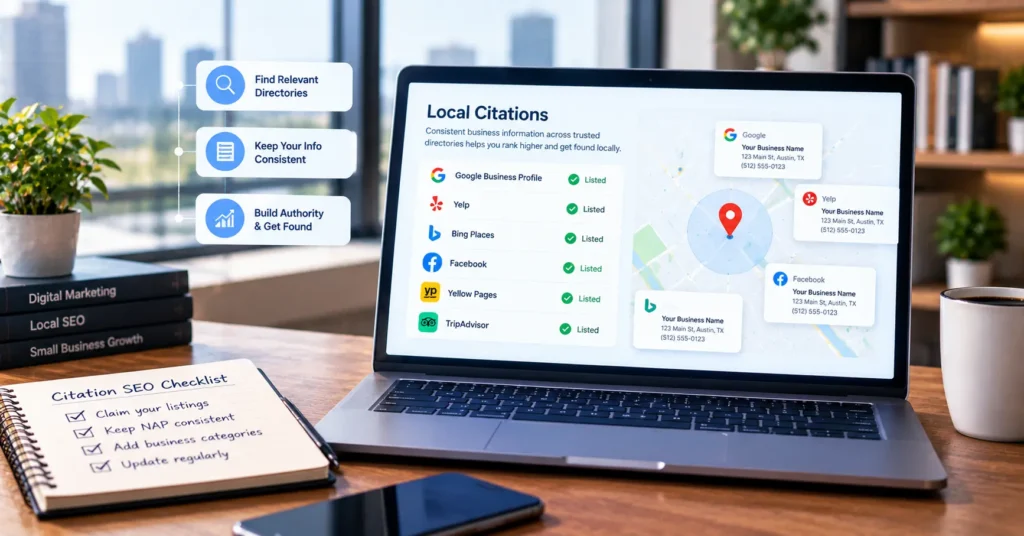
In SEO, a citation is an online mention of your business’s name, address and phone number, usually on a directory, a map or another site that is not your own. Citation SEO is the work of finding those mentions, correcting them and adding the ones that matter, so your details are accurate and consistent wherever people look.
This guide explains what citations are, whether they help your rankings, the main types, how to build and clean them up, and the mistakes to avoid. It is written for small businesses and uses Google’s own help pages wherever it can.
A citation is a mention of your business’s name, address and phone number on another site. Google does not publish citations as a ranking factor. It says local results are based mainly on relevance, distance and prominence, and that inaccurate business information can stop your profile appearing for relevant searches. So the safe approach is to keep your details accurate and the same everywhere, and to treat citations as support, not a trick.
Table of contents
What a citation is
A citation, in local SEO, is any place on the web that lists your business details. The core details are your name, address and phone number, often shortened to NAP. Many citations also include your website, opening hours, categories and a short description.
They appear in many places: general directories, map and navigation services, review sites, industry bodies, chamber of commerce lists, local news sites and social profiles. A citation does not need a link to your website to count as a mention, although many include one.
An example
Imagine a plumber called Harbour Plumbing, based at 12 Quay Street. A citation is any listing that shows “Harbour Plumbing, 12 Quay Street, with a phone number”. It could be in a trade directory, a council business list or an online map. This is a made up example, used only to show the idea.
Why the word is confusing
“Citation” also means a reference to a source in an essay, and a link to a source in an AI answer. This guide is about local business citations, with a short section on the AI meaning later.
Do citations help rankings?
The honest answer is: probably a little, and indirectly. Google’s help page on improving your local ranking says local results are based mainly on relevance, distance and prominence. It describes prominence as how well known a business is, based on things like how many websites link to your business and how many reviews you have. It does not list citations by name. It also says there is no way to request or pay for a better local ranking.
The same page says that if your business information is not accurate, your profile might not show up for relevant searches in your area. That is the strongest reason to care. Wrong details make it harder for Google and for customers to be sure who you are and where you are.
What citations do well
- Accuracy. A correct listing sends customers to the right place at the right time.
- Consistency. The same details in many places help systems confirm they belong to one business.
- Extra visibility. Some directories bring their own visitors, even if rankings do not change.
- Trust. Listings on respected sites, such as industry bodies, show that you are a real business.
What they do not do
They are not a shortcut. Adding your business to hundreds of low quality directories will not outrank a competitor who has better reviews, a more complete profile and a more useful website. Treat citations as a foundation, not the whole job.
Types of citation
It helps to know the main kinds, because they need different effort.
| Type | Examples | Worth the effort? |
|---|---|---|
| Major platforms | Map and search profiles, social business pages | Yes, always, and keep them current |
| Industry and professional | Trade bodies, licensing boards, association member lists | Yes, they carry real trust |
| Local | Chamber of commerce, council or town directories, local news sites | Yes, if they are genuine |
| General directories | Broad business listing sites | Selectively, the better known ones |
| Review and recommendation sites | Platforms where customers rate businesses | Yes, where your customers look |
| Low quality or spammy | Pages that list thousands of unrelated businesses | No |
Structured and unstructured citations
A structured citation is a formal listing with fields for name, address and phone number, such as a directory entry. An unstructured citation is a mention in running text, such as a news article about your opening. Both count as mentions. Structured ones are easier to manage, and unstructured ones tend to come from real coverage.
Getting your details right
Before you add or fix anything, agree the exact version of your details. Write it down once and copy it every time.
- Name. Use your real business name as it appears on your sign and website. Google’s guidelines say your name should reflect the real-world name, so do not add keywords.
- Address. Use one format, including suite numbers and abbreviations such as “Street” or “St”, and stick to it.
- Phone. Use the main number that you answer. If you use a tracking number, keep it as an extra number, not the main one.
- Website. Link to the same page everywhere, usually the homepage or the location page.
- Categories and description. Use the closest category and a short, honest description.
Your website should show the same details as the listings. Google’s page on local business structured data lets you share details such as opening hours, though it says features are not guaranteed to appear.
Addresses that cause trouble
Google’s guidelines say a service area business cannot list a virtual office unless it is staffed during business hours, and that a rented mailing address with no operating business there is not eligible for a profile. Do not use such addresses for citations either, because they invite mismatches and suspensions.
How to build and clean up citations
You can do this with a spreadsheet and some patience. A paid tool can save time on larger projects, but it is not required.
- Search for your business. Search by name, by phone number and by old addresses. Note every place you find.
- Record what each listing says. In a spreadsheet, note the site, the name, address, phone, website and any mistakes.
- Fix the major platforms first. Correct your main profiles, because they matter most and are seen most.
- Correct or claim the rest. Update wrong listings. If you cannot edit one, use the site’s contact or claim process.
- Remove duplicates. Two listings for the same place confuse customers and systems. Ask the site to merge or remove the extra one.
- Add missing relevant listings. Look at industry bodies, local directories and the sites your competitors appear on.
- Keep a log. Note the date and login for each listing, and review them twice a year.
Which new listings to add
Ask three questions: would a customer look here, is the site real and well maintained, and does it accept honest, accurate details? If the answer to any is no, skip it. Ten good listings beat a hundred poor ones.
When your details change
If you move, change your phone number or rename the business, plan the update before the change. List every place that needs correcting, update the biggest ones first and keep checking for old versions for several months afterwards.
Citations vs backlinks
They are related, but they are not the same thing.
| Citation | Backlink | |
|---|---|---|
| What it is | A mention of your business details | A link from another site to yours |
| Needs a link? | No | Yes |
| Main job | Accuracy and consistency | Signalling that your page is worth visiting |
| Where it matters most | Local searches | All searches |
Many citations include a link, so they can be both. Our guide to local SEO explains where each fits.
Common mistakes
- Different details in different places. A suite number here and not there, a new phone number on one site only.
- Duplicate listings. Often caused by a move or a name change.
- Chasing quantity. Hundreds of poor directories add work and no value.
- Paying for a list you cannot see. Ask which sites will be used and keep the logins yourself.
- Using a virtual address. It can break Google’s rules.
- Forgetting after set up. Details drift as sites change, so review them.
Citations in AI answers
The word is now used for something else too. When an AI tool writes an answer, it may show links to the pages it used, and marketers call those links citations. Being cited in that sense depends on having clear, useful, trustworthy pages, not on directory listings.
The two meanings share one idea: consistent, accurate information about your business in places that people and systems trust. Keeping your listings correct helps with both. For more, see our guide to SEO.
How to check it is working
Citations are a quiet kind of work, so look for small signals.
- Fewer wrong calls and visits. Customers stop arriving at the wrong address or ringing a dead number.
- Cleaner searches. A search for your name shows consistent details across the first results.
- Profile performance. Your Google Business Profile shows views, calls and direction requests over time.
- Referral traffic. Some directories send visitors you can see in analytics.
Do not expect a jump in rankings from citations alone. If rankings are your goal, look at reviews, profile completeness and your website too, as covered in our guide to local SEO services.
Citation SEO FAQ
What is an example of a citation?
A business listing in an online directory that shows the business name, address and phone number. A mention of your business in a local news article, with the same details, is another.
What does SEO mean in simple terms?
SEO means search engine optimization: improving a website and its online presence so that it appears in more relevant searches. Citations are one small part of it.
Is SEO still relevant in 2026?
Yes. People still search, and accurate information that is easy to find still matters. The way results look keeps changing, but clear, consistent details on trusted sites remain useful.
What are the four types of SEO?
There is no official list. One common grouping is on page, off page, technical and local SEO. Citations belong to local SEO, with some overlap with off page work.
How many citations do I need?
There is no magic number. Start with the major platforms and the most relevant industry and local sites. Add more only if they are real and useful.
Do I have to pay for citations?
No. Most useful citations are free, such as your main profiles, industry bodies and local directories. Be cautious about paying for a large package of listings, and ask which sites will be used before you agree.
Should every citation link to my website?
Where a site allows a link, point it to a relevant page on your own site, usually the homepage or the location page. If a site does not allow links, a mention with accurate details is still useful.
Where to start
Start by writing down your business name, address and phone number exactly as they should appear. Then search for your business and list what you find. Fix the major platforms first, merge duplicates and add two or three relevant listings you are missing.
If you want a second opinion, Torplix offers a free audit of your profile and website, with a written list of fixes in priority order. It is yours to keep whether or not you work with us, and we do not promise rankings. See our small business SEO services for how we work.