
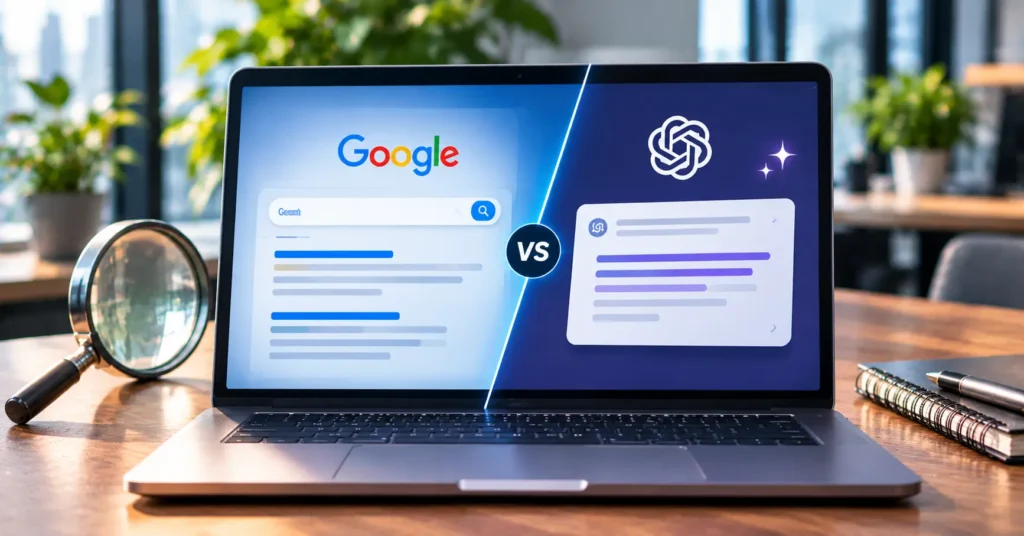
SEO is the work of earning visibility in search engine results. GEO, short for generative engine optimization, is a newer name for the work of being mentioned and cited in answers written by AI tools such as ChatGPT, Perplexity and Google’s AI Overviews. The two overlap far more than the headlines suggest.
This guide explains each term, where they overlap and where they differ, what Google and independent research say, and what a business should do about it. It tries to stay calm, because this is a topic where hype is easy to find.
GEO has not replaced SEO. Most GEO advice is good SEO described in new words: clear, useful, crawlable pages from a source people trust. Google says in its documentation on AI features and your website that there are no additional requirements to appear in AI Overviews or AI Mode, and no special optimizations are necessary. Do the SEO well first, then watch how AI tools mention your brand.
Table of contents
What SEO is
Search engine optimization is the practice of improving your website so that it can be found, understood and trusted by search engines, and so that it appears when people search for what you offer. It covers technical health, page content, links from other sites and, for businesses with a physical presence, local profiles. Our SEO guide covers it in depth.
The goal is clicks and visits from a list of results. Success is usually measured in rankings, impressions, clicks and, ideally, enquiries and sales.
What GEO is
Generative engine optimization is the practice of making your content and brand more likely to be used in answers produced by generative AI tools. Those tools read many sources, write a combined answer and sometimes show links to the pages they used. GEO aims to get your pages used, quoted or recommended.
GEO is a marketing term. Google’s own documentation does not use it, and you will also see AEO, for answer engine optimization, and other labels for the same idea. The names are still settling, so judge any offer by what the work is, not by what it is called.
GEO vs SEO side by side
| SEO | GEO | |
|---|---|---|
| Where you appear | A ranked list of results | Inside a written AI answer, often with a few links |
| Main goal | Clicks and visits to your pages | Being mentioned, cited or recommended |
| How you are measured | Rankings, impressions, clicks, enquiries | Mentions and citations, harder to count |
| Core work | Technical health, content, links, local profiles | The same, plus clear brand facts and wider mentions |
| Rules and guidance | Published by search engines | Mostly informal and still changing |
| Speed of feedback | Weeks to months | Unclear, and varies by tool |
The table shows that the differences are about where you show up and how you measure it. The work that helps is more alike than different.
Where they overlap
Most of what is said to help in AI answers is the same as what already helps in search.
Pages that can be crawled and read
If search engines cannot reach or read your pages, neither can the tools that rely on them. Google’s page on AI features lists examples of best practice that still apply, such as allowing crawling, linking internally and keeping important content in text.
Useful, original content
A page that answers a question clearly and adds something new, such as your own process, data or experience, is more likely to be used than a page that repeats what others say.
Clear facts about who you are
Your name, what you do, where you work and how to contact you should be consistent across your site and your profiles. This helps both search engines and AI tools describe you correctly.
Trust from other places
Mentions and links from reliable sites that know your work help your standing in search. They also give AI tools more places to see your brand named.
Where GEO differs
There are some real differences worth knowing about, even if they do not call for a separate programme.
The answer may be the end of the journey
A person can read an AI answer and never visit a site. That makes clicks a weaker signal of success, and it makes being named in the answer more important than it was in a list of links.
Your wider reputation counts more
Because an AI tool reads many sources, what others say about you, such as reviews, directories and articles, can shape how you are described. It is worth checking that these sources are accurate.
Format helps extraction
Short direct answers, clear headings and plain lists make it easier for any system, human or machine, to pull out the right part of a page. This is also good writing for readers.
Results vary from one tool to the next
Each AI tool has its own sources and behaviour, and the same question can give different answers on different days. That makes consistent measurement hard.
What the evidence says
Two sources are useful here: what Google says about its own AI features, and what independent research has found about how people use them.
What Google says
Google’s page on AI features says there are no additional requirements to appear in AI Overviews or AI Mode, and no special optimizations are necessary. It says a page needs to be indexed and eligible to appear in Search with a snippet, and it notes that eligibility does not guarantee a page will be crawled, indexed or shown. It also says the best practices for SEO remain relevant. This covers Google’s features only, not other AI tools.
What independent research found
The Pew Research Center analysed the Google browsing of 900 US adults in March 2025. In its study, users who saw an AI summary clicked a traditional result in 8% of visits, against 15% when there was no summary. Clicks on a link inside the summary were 1% of visits. AI summaries appeared in 18% of the searches Pew looked at.
This is one study of one country at one time, and AI features have changed since. It still points to a real trend: where an AI summary appears, fewer people click through. It does not show that SEO has stopped working. It shows why being the source that is cited, and being visible beyond the click, deserves attention.
What to do about it
You do not need a separate project. You need the foundations done well, plus a few extra habits.
- Fix the SEO basics first. Make sure your key pages are crawlable, load fast, work on a phone and are linked from your main navigation.
- Write direct answers. Put a short, clear answer near the top of pages that answer a question, then give the detail.
- Add what only you know. Original examples, your process, your own data and clear opinions are harder to copy than general advice.
- Keep your facts consistent. Check your business name, services, location and contact details on your site and main profiles.
- Earn mentions from reliable sources. Publish something worth citing, and be listed accurately in the directories and associations in your field.
- Keep structured data honest. Google says to keep it consistent with the visible text on the page.
- Ask the tools about yourself. Search for your brand and services in a few AI tools, record what they say and correct any errors at the source.
- Keep measuring visits and enquiries. They are still what pays the bills.
Our guide to AI looks at the wider picture of AI in marketing, and our SEO services page explains how we approach the foundations.
How to measure AI visibility
Measurement is the weakest part of GEO. Several tools claim to track how often your brand appears in AI answers, but the answers change from one question to the next, so any score is an estimate.
- Manual checks. Ask the same set of questions each month in the main AI tools and note whether you are mentioned and how.
- Referral traffic. Look at your analytics for visits from AI tools, which may be small, but are a direct signal.
- Branded search. If more people search for your name, that may reflect wider awareness.
- Search Console. Impressions and clicks still show how you perform in Google Search.
- Enquiries. Ask new customers how they heard of you and include AI tools in the options.
Be careful with any tool or report that gives a single score without explaining how it was worked out.
How to spot hype
Because the field is new, some claims go further than the evidence. Watch for these.
- “SEO is dead.” Google’s own documentation says SEO best practices remain relevant to its AI features.
- Secret files or markup. Google says you do not need new machine readable files, AI text files or special markup for its features.
- Guaranteed mentions. No one controls what an AI tool writes.
- A single visibility score. If it cannot be explained, it cannot be trusted.
- Urgency. If you must buy this week, be suspicious.
Who needs to care first
Some businesses will feel the change sooner than others.
- Publishers and information sites. Their pages answer questions that AI summaries can answer directly.
- B2B and software companies. Buyers research with AI tools, so being described correctly matters.
- Local businesses. Reviews and accurate profiles feed both maps and AI answers.
- Online stores. Product data and reviews affect how products are described and compared.
A business with steady demand from local search or referrals can reasonably keep the focus on the foundations and review again in a few months.
GEO vs SEO FAQ
Has GEO replaced SEO?
No. SEO still drives visits from search results, and Google says its best practices remain relevant to AI features. GEO is better seen as an extension of the same work, with extra attention to how your brand is described.
Is SEO dead now with AI?
No, but the results page is changing. Where an AI summary appears, Pew found fewer clicks on traditional results. That makes quality, trust and being named more important, not less.
What is the difference between GEO and AEO?
The terms are used in overlapping ways. AEO, or answer engine optimization, usually refers to being the source for direct answers, and GEO to being used in AI written answers. In practice the work is the same, so do not pay extra for the label.
Do I need a GEO agency?
Not as a separate purchase. Ask any provider what they do that is not already good SEO and how they would measure it. If they cannot explain, treat the offer with caution.
Where to start
Start with your pages. Check that your most important pages can be crawled, answer questions directly and carry accurate business details. Then ask a few AI tools about your business and write down what they say. That one hour will tell you more than most reports.
If you want a second opinion, Torplix offers a free audit of your site, with a written list of fixes in priority order. It is yours to keep whether or not you work with us, and we do not promise rankings or mentions. We do not sell GEO as a separate package, because the foundations come first. See our SEO services for how we work.