
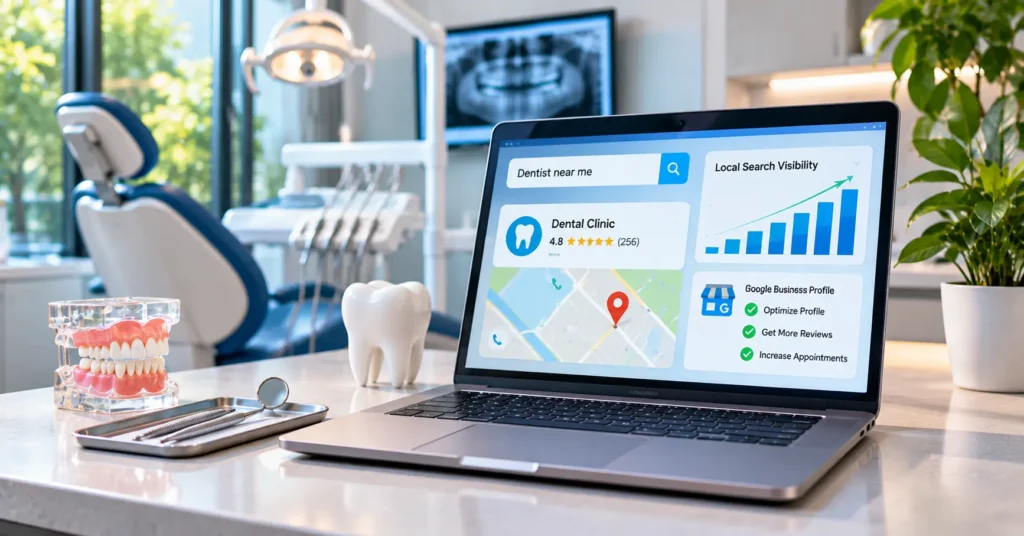
Local SEO for dentists is the work of making your practice easy to find when people nearby search for a dentist. If someone types “dentist near me” or “emergency dentist in Leeds”, local SEO helps decide whether your practice appears on the map and in the results around it.
This guide explains how patients find a dentist on Google, how local results are ranked, and what to do about your Google Business Profile, reviews, website and listings. It also covers the rules dental practices should keep in mind, what it costs and how to tell whether it is working.
Local SEO for dentists means keeping your Google Business Profile complete and accurate, earning genuine reviews, giving each location and treatment a clear page on your website, and keeping your name, address and phone number the same everywhere. Google says local results are based mainly on relevance, distance and prominence, and that you cannot pay for a better local ranking. Most of the work is careful, regular housekeeping.
Table of contents
- What local SEO for dentists is
- How Google ranks local results
- Set up your Google Business Profile
- Reviews
- Your website
- Listings and consistency
- Content patients actually read
- Searches for urgent care
- Several locations and several dentists
- Privacy and advertising rules
- Common mistakes
- How to measure results
- Cost, and doing it yourself or hiring
- FAQ
- Where to start
What local SEO for dentists is
Local SEO is the part of search engine optimization that helps a business show up for searches tied to a place. For a dental practice, the place is the area your patients travel from. The searches are things like “dentist near me”, “family dentist in Bristol” or “emergency dental care open now”.
These searches often show a map with a short list of practices, followed by regular web results. The map is where most local attention goes, and it is built mostly from your Google Business Profile, not from your website alone. That is why local SEO for dentists starts with the profile and then extends to the website, reviews and listings.
Why it suits dental practices
- Patients travel a short distance. Many people choose a dentist close to home or work.
- The search often has urgency. Someone with a toothache wants an answer now, and the top few results get the call.
- Trust matters a lot. Reviews, photos and clear information help a nervous patient choose you.
- The decision is local. A national website is not the competition, the practices down the road are.
How Google ranks local results
Google’s help page on improving your local ranking says local results are based mainly on relevance, distance and prominence. It also says you cannot request or pay for a better local ranking.
| Factor | What it means for a dentist | What you can do |
|---|---|---|
| Relevance | How well your profile matches what the person searched for | Complete every field, pick the right category, describe your treatments |
| Distance | How far you are from the searcher or the place they named | Keep your address accurate, but you cannot move closer |
| Prominence | How well known and trusted your practice is | Earn reviews, be mentioned on reliable sites, build a useful website |
Distance is the one you cannot change. That makes the other two more important, and it explains why a practice slightly further away can still win when its profile is more complete and better reviewed.
Set up your Google Business Profile
Your Google Business Profile is the free listing that appears on the map and in the panel beside the results. For many practices it is where new patients first see you, so it is the best place to start.
Claim and verify it
Search for your practice and check whether a profile already exists. Claim it and complete the verification Google asks for. You cannot reply to reviews or edit key details until you have verified the profile.
Use your real name
Google’s guidelines say your name should reflect your business’s real-world name, and that unnecessary information is not permitted. Do not add keywords such as “best cheap dentist” to the name. It can get the profile suspended.
Understand practitioner profiles
The same guidelines name dentists as individual practitioners. When several practitioners work at one location, the practice has its own profile, and a practitioner’s profile is titled with only the practitioner’s name. A single practitioner should not create several profiles to cover each specialty. If your practice has a mix of dentists, check which profiles you need before creating any.
Fill in the details
- Category. Choose the main category that describes you best, then add secondary categories only where they are true.
- Hours. Keep regular and holiday hours current. Wrong hours are one of the quickest ways to lose a patient’s trust.
- Services. List the treatments you offer, such as check ups, hygiene, emergency care and cosmetic work.
- Photos. Add real photos of the entrance, the waiting room, the treatment rooms and the team, with permission.
- Booking link. Link to your booking page, if you have one.
- Description. Write a short, honest description of what makes your practice different, without stuffing it with keywords.
Reviews
Reviews affect how prominent your practice looks, and they often decide which practice a patient calls. Google’s page on managing customer reviews says replying shows customers you value their feedback, and that the person who wrote the review is notified when you reply.
How to ask
Ask every patient who seems happy, soon after the visit, and make it easy: send a text or email with the direct link to your review page. Ask in your own words and never write the review for them. Check Google’s review policies before you offer anything in return, because some incentives are not allowed.
How to reply
- Reply to all of them. Thank people who are happy and respond calmly to those who are not.
- Keep it short and general. Do not repeat details of a person’s treatment.
- Take complaints offline. Invite the person to call the practice so you can sort it out privately.
- Flag false reviews. Google says you can flag a review that violates its content policies.
Be careful about patient privacy
Replying to a review can reveal that someone is a patient. Privacy rules for health care, such as HIPAA in the US, may restrict that, and dental regulators in other countries have their own rules. Reply in general terms, do not confirm that the person was treated and check with your compliance adviser if you are unsure. This is general information, not legal advice.
Your website
The website supports the profile. It gives Google more detail about what you do and where, and it gives patients the information they need to book.
Give each location a page
Every practice location should have its own page with the address, phone number, opening hours, a map, parking and transport details, the team and a clear way to book. The page should be written for that location, not copied from another one with the town name swapped.
Give each treatment a page
Create a page for each main treatment, such as general dentistry, emergency appointments, hygiene, implants and cosmetic work. Explain what the treatment is, who it suits, what happens at the visit and what patients can ask. Pages like these match the way people search, and they answer the questions that stop people booking.
Make the contact details easy to find
Put your phone number and booking link at the top of every page, and make sure they work on a phone. Many local searches happen on a phone.
Add structured data
Google’s page on local business structured data says you can tell Google about business hours and other details, and that features are not guaranteed to appear. It is worth adding, but treat it as a helper, not a ranking trick.
Our dental SEO service covers how we approach the website side for practices.
Listings and consistency
Your practice appears on many sites besides Google: directories, insurance provider lists, health portals and maps. The details on all of them should match your profile and your website exactly.
- Name. Use the same practice name everywhere.
- Address. Use the same format, including suite numbers.
- Phone. Use the same main number, and make sure it is answered.
- Website. Link to the same page on every listing.
Check the main directories and the lists from the insurers and associations you belong to. Fix wrong or old entries, and close duplicates. Our guide to what local SEO is explains why consistency helps.
Content patients actually read
You do not need a large blog. A few helpful pages are enough, as long as they answer real questions. Think about what patients ask on the phone.
- What to do in a dental emergency, and when to call
- What a first visit involves
- How much common treatments cost, or what affects the price
- Which insurance plans you accept
- What to expect after a procedure
- How to ease worries before a visit
Write in plain language and keep the information accurate. Link to related treatment pages so patients can keep reading and Google can see how your pages connect.
Searches for urgent care
Emergency searches are some of the most valuable a practice can win, and they follow different rules from “dentist near me” searches. The patient is in pain, short of time and ready to call the first practice that looks open and able to help.
- Say what you offer. If you take emergency appointments, say so on your profile, your homepage and a dedicated page.
- Keep hours accurate. A person who calls a practice that is shown as open and finds it closed will not call again.
- Make the number easy to tap. The phone number should be a link on mobile, and the page should load quickly.
- Answer the call. If calls go to voicemail during opening hours, the search work has been wasted.
- Explain what to do now. A short, calm page about what to do while waiting helps people and builds trust.
Do not claim to offer emergency care you cannot deliver. If your hours or capacity are limited, say so plainly.
Several locations and several dentists
Groups and larger practices have more to manage. Each location needs its own profile, page and set of reviews, and the details must not be mixed up.
- One profile per location. Each real practice location gets its own profile.
- One page per location. Unique content, with the local team and local details.
- A shared standard. Agree on names, categories, photos and how to reply to reviews, so no location is left out.
- Someone in charge. Decide who owns the profiles, because they are often set up and then forgotten.
Privacy and advertising rules
Dental practices work under rules that many other businesses do not. These can affect your profile, your reviews and your website.
- Patient privacy. Do not reveal patient details in review replies, photos or case stories without proper consent.
- Advertising rules. Dental boards and regulators often limit what you can claim, such as superlatives like “best”, before and after photos, or promises of outcomes.
- Testimonials. Some regulators have rules about how patient testimonials can be used in advertising.
These rules vary by country and by state, so check the ones for your market with your dental board or association. This section is general information, not legal advice.
Common mistakes
- Stuffing the profile name with keywords. It risks suspension.
- Leaving wrong hours or phone numbers. It costs patients and trust.
- Ignoring reviews. Unanswered complaints put people off.
- Copying one location page for every town. Pages need to be written for each place.
- Letting a third party own the profile. Make sure you hold the main owner role.
- Buying fake reviews. It breaks Google’s rules and can be spotted.
How to measure results
Measure the things that matter to a practice: calls, booking requests and new patients, not just rankings.
- Business Profile performance. Google’s performance help says verified profiles show how many people viewed the profile, called, asked for directions and clicked the website link.
- Search Console. The performance report shows which searches bring people to your site, with clicks and impressions.
- Your own records. Ask new patients how they found you and log it, and count calls from tracked numbers if you use them.
Look at the trend over months, not days. Local results move around, and results can differ from what you see when you search yourself, because they depend on location and device.
Cost, and doing it yourself or hiring
You can do a lot yourself. Claiming the profile, filling it in, asking for reviews and keeping details consistent need time and care, not special skills. Help makes more sense when you have several locations, little time or a very competitive area.
If you do hire, prices vary. One agency guide we reviewed in October 2026 put local SEO at roughly $100 to $3,000 a month, depending on scope and market. Treat that as a broad guide, not a quote. Our guide to local SEO services explains what help includes and what it costs.
Local SEO for dentists FAQ
How much does local SEO cost?
It can cost your time only, if you do it yourself, or a monthly fee if you hire help. The agency guide we reviewed in October 2026 gave a range of roughly $100 to $3,000 a month. Ask what is included, who does the work and how results are reported.
What is local SEO for dentists?
It is the work of making a dental practice easy to find in searches by people nearby. It covers your Google Business Profile, reviews, website pages and listings.
What is SEO in dentistry?
It means improving a dental practice’s website and online presence so it appears more often when people search for dental care. Local SEO is the part that focuses on searches tied to a place.
What is the 80/20 rule in dentistry?
It is a general rule of thumb, not an SEO rule. It says that a small share of patients or treatments often brings a large share of revenue. It is worth checking against your own numbers before you decide where to focus your marketing.
How long does local SEO take to work?
Fixing a profile can show an effect in weeks, while reviews and website pages take longer. Google’s SEO Starter Guide says some changes take a few hours and others several months, so judge the trend over time.
Do I need a blog?
Not necessarily. Treatment pages, location pages and a handful of helpful articles do more than a blog that is rarely updated.
Should I use a tracked phone number?
It can help you see which sources bring calls. If you do, keep your main number on your Google Business Profile and listings, and make sure the number on your website matches it, or list the tracked one as an additional number. Inconsistent numbers can confuse patients and listings.
Where to start
Start with your Google Business Profile. Claim it, verify it, check the name, hours and phone number, add real photos and ask your next five happy patients for a review. Then make sure each location and main treatment has a clear page on your website.
If you want a second opinion, Torplix offers a free audit of your profile and website, with a written list of fixes in priority order. It is yours to keep whether or not you work with us, and we do not promise rankings or new patient numbers. See our dental SEO service for how we work.