
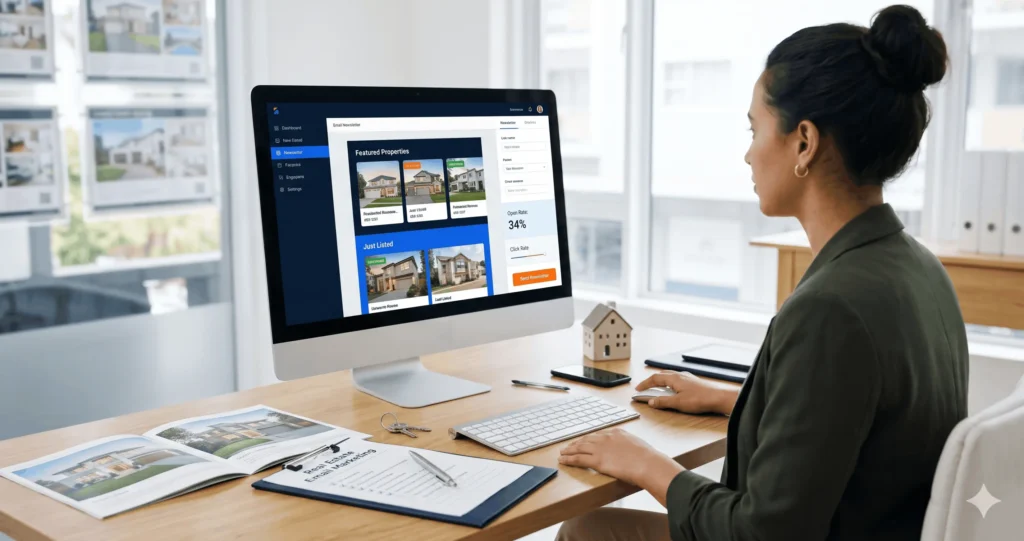
Real estate is a business of relationships and timing. Most people buy or sell a home only a few times in their lives, so the agent they remember when the moment comes often wins the work. Email is one of the cheapest ways to stay remembered without being pushy.
This guide explains how to build a list properly, which campaigns suit agents and teams, what to write, how to stay inside the email and fair housing rules and how to tell whether it works. It does not quote open rates, prices or list sizes, because they vary too much between markets and platforms to be useful.
Real estate email marketing works when you collect addresses with permission, send useful messages on a steady schedule and follow the rules. Start with a simple monthly local update, a new listing alert and a message to past clients. In the United States, the FTC’s CAN-SPAM guide says commercial email must have accurate sender details, no deceptive subject lines, a valid postal address and a clear way to opt out.
Table of contents
Why email works for agents
Social platforms change their rules and reach all the time. An email list is yours. You can write to the people on it directly, whenever you choose, without paying for each message.
Email also suits the long cycle of a property decision. Someone who is not ready to move this year may be ready next year, and a useful message every month keeps you in their mind. That is why the best real estate email is patient. It is about being helpful over time, not about chasing a sale in each send.
Build your list
The quality of your list matters more than its size. Collect addresses from people who have a real reason to hear from you.
- Past clients. Buyers and sellers you have worked with are your best audience, so make sure they are on the list and know they can leave it.
- Your sphere. Friends, neighbours and contacts who know you personally.
- Website sign ups. Offer something useful in return, such as a local market report or a home value estimate request.
- Open house sign in. Ask visitors whether they would like to receive listings and updates, and record their answer.
- Enquiries. People who contact you about a property may want future alerts, but ask first.
Do not buy lists or scrape addresses. People who did not ask to hear from you mark messages as spam, which damages your sending reputation for everyone else on your list.
Rules to follow
Three sets of rules apply to most agents.
Email laws
In the United States, the CAN-SPAM Act sets the rules for commercial email. The FTC’s compliance guide lists the main requirements. Other countries, including the UK, EU members and Canada, have their own laws, and some require consent before you send. Check the rules for where your recipients live.
Fair housing
Real estate advertising is covered by fair housing laws. The US Department of Justice explains the Fair Housing Act, which prohibits discrimination in housing. Review your email wording and images so that nothing states a preference or limitation. Ask your broker or compliance officer to review your templates, because local and state rules add to the federal ones.
Brokerage and licensing rules
Many brokerages and regulators require your licence number, brokerage name or a disclaimer on marketing. Check what applies to you and put it in the template once, so it appears on every send.
Campaigns to send
You do not need dozens of campaigns. A few well run ones cover most of the value.
| Campaign | Who gets it | What it does | How often |
|---|---|---|---|
| Local market update | Everyone on the list | Shows you know the area | Monthly |
| New listing alert | People who asked for listings | Brings buyers to your properties | When a listing goes live |
| Just sold and results | Neighbours and past clients | Shows recent activity and builds trust | After a sale, where rules allow |
| Open house invitation | Nearby contacts and buyers | Drives visits | Before each event |
| Buyer or seller series | New enquiries | Answers the first questions in order | A short sequence over a few weeks |
| Past client check in | People you have helped | Keeps you in mind for referrals | A few times a year |
| Home anniversary | Past buyers | Creates a friendly touch point | Once a year |
Start with the first three. Add a series for new enquiries once your list is growing.
What to write
Real estate emails fail when they read like advertisements. Aim to be useful first.
- Use a clear subject line. Say what is inside. Avoid tricks, which break the deceptive subject line rule and annoy readers.
- Write for one person. Use “you” and keep sentences short.
- Give one main idea. A single message with a single call to action is easier to act on.
- Use real photos and local detail. Mention the street, the school catchment, the new café and the change in the market that you actually see.
- Make the next step easy. A button to book a viewing or reply, not a long list of links.
- Sound like a person. Sign with your name, and use a reply address that someone reads.
Content ideas that are not listings
If every email is a listing, people stop reading. Mix in a short market note, a tip for sellers on preparing a home, a guide for first time buyers, a local event round up or an answer to a question clients often ask.
Subject lines that say what is inside
These are made up examples to show the style. Each tells the reader what they will get.
| Type | Example subject line |
|---|---|
| Market update | What happened to home prices on Maple Street this month |
| New listing | New listing: three bedroom house near the park |
| Open house | Open house this Saturday at 2 pm, 14 Oak Lane |
| Seller tip | Five small jobs that help a home show well |
| Past client | Thinking of you, and a quick update on the neighbourhood |
Design the template once
Choose a simple layout with one column, your photo and logo, large readable text and one button. Keep a short footer with your licence number, brokerage, postal address and unsubscribe link. Preview every message on a phone before you send, since most people read email there. Reusing one template keeps your work fast and your brand consistent.
Segments
Sending the same message to everyone wastes attention. Even simple groups help.
- Buyers and sellers. They want different information.
- By area. People care most about their own neighbourhood.
- By stage. A new enquiry needs a different message from a client you closed for two years ago.
- By interest. Someone who clicked on condos wants different listings from someone who clicked on family homes.
Our guide to targeted email marketing explains how to set up groups and send relevant messages.
Getting into the inbox
A message nobody sees is wasted. Mailbox providers check who is sending, and agents who send in volume should set this up properly. Google’s email sender guidelines say that all senders to Gmail accounts should set up SPF or DKIM authentication and keep their spam rate reported in Postmaster Tools below 0.3 percent, and that senders of more than 5,000 messages a day must meet extra requirements.
- Send from a domain you own, with authentication set up by your email platform.
- Include a clear unsubscribe link and honour requests promptly.
- Remove addresses that bounce or never engage.
- Send consistently, so your volume does not jump suddenly.
How to measure it
Open rates are less reliable than they used to be, because some mail apps load images automatically. Look at actions as well.
- Clicks. Which links did people tap, and which listings or guides drew the most interest?
- Replies. A reply is the best sign of a warm contact.
- Enquiries. Count calls, form fills and viewing requests that follow a send.
- Unsubscribes and spam complaints. A rise tells you the content or frequency is wrong.
- Business results. Track which clients came from email, and how long it took.
Our guide to ecommerce email marketing shows how to track results in a shop, and many of the same ideas apply.
A 90 day plan
This is a plan to adapt, not a promise of results.
| Weeks | Focus | Actions |
|---|---|---|
| 1 to 2 | Set up | Choose a platform, add your licence and brokerage details to a template, check the rules with your broker |
| 3 to 4 | Build the list | Import consented contacts, add a sign up form to your site and a sign in sheet for open houses |
| 5 to 8 | Send | Send a monthly market update and a new listing alert, and write a short series for new enquiries |
| 9 to 12 | Review | Check clicks, replies and enquiries, drop what does not work and add a past client message |
Common mistakes
- Adding people without asking. It breaks the rules and damages your sender reputation.
- Only sending listings. Readers tire of adverts.
- No unsubscribe link or postal address. Both are required in the United States.
- Images with no text. Many mail apps block images, and a message made only of a picture shows as blank.
- Inconsistent sending. Long gaps followed by a burst look like spam.
- Ignoring fair housing. A careless phrase or image can create a legal problem.
Real estate email FAQ
What is the 60/40 rule in email?
It is a rule of thumb, not a law, and sources describe it in different ways. A common version is to send mostly useful content and keep promotional messages to a smaller share. Use it as a reminder to give value, not as a formula.
What is the 80/20 rule in email marketing?
It is another rule of thumb with several versions. The usual idea is that most of your results come from a small part of your list or your campaigns, so find that part and look after it.
How often should I email?
Monthly suits most agents for general updates, plus listing alerts when they are relevant. Watch unsubscribes and replies, and adjust if people tire of the messages.
Do I need a CRM?
A basic email platform is enough to start. A customer relationship tool helps once you want to track each contact’s interests and your follow up, but it is a second step.
Where to start
Gather the contacts who have agreed to hear from you, put your licence and brokerage details in a clean template and send a short local market update this month. Then add a listing alert and a message to past clients.
We have no real estate clients to show. What we offer is a free review of your current email and website, with a written list of what to fix first. See our email marketing service, read our guide to real estate SEO or book a free call to get started.